
Cleans the fuel pathway
Targets gums, varnishes, lacquer, sludge, and carbon from the tank and lines through injectors and combustion surfaces.
A multi-stage fuel additive and full-spectrum fuel-system treatment engineered for heavy-duty fleets, high-mileage diesel applications, and modern high-performance engines.

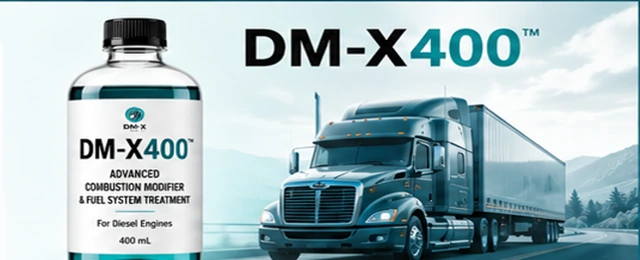
DM-X400™ is designed to work across the complete fuel journey: dissolve low-temperature residues, restore injector precision, attack high-heat carbon, and modify combustion behavior inside the cylinder.
Targets gums, varnishes, lacquer, sludge, and carbon from the tank and lines through injectors and combustion surfaces.
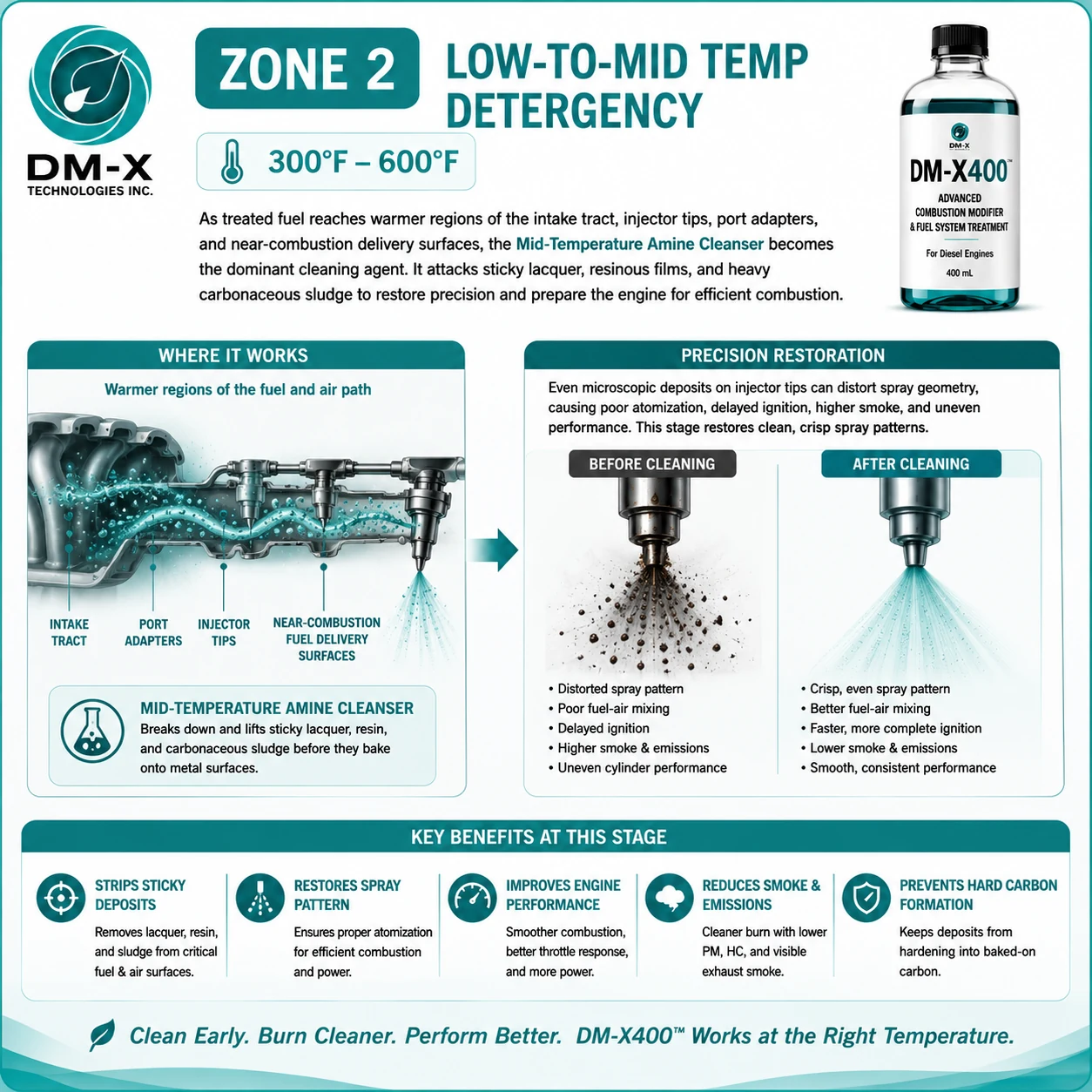
Helps remove injector-tip deposits that distort spray geometry and produce oversized, poorly mixed fuel droplets.
Uses the proprietary polymeric matrix to support finer droplet breakup and more complete in-cylinder fuel conversion.
Supports fuel lubricity, reduces contaminant-related stress, and helps preserve pumps, injectors, and engine cleanliness.
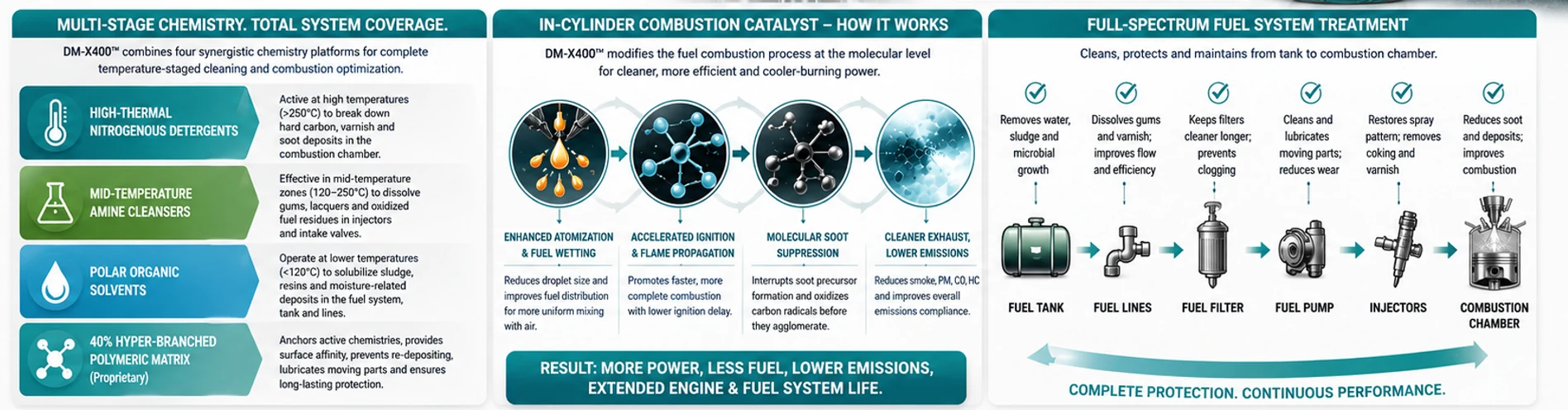
Rather than asking one detergent to survive every thermal condition, DM-X400™ combines specialized chemistries that become most useful at different points in the fuel and combustion process.
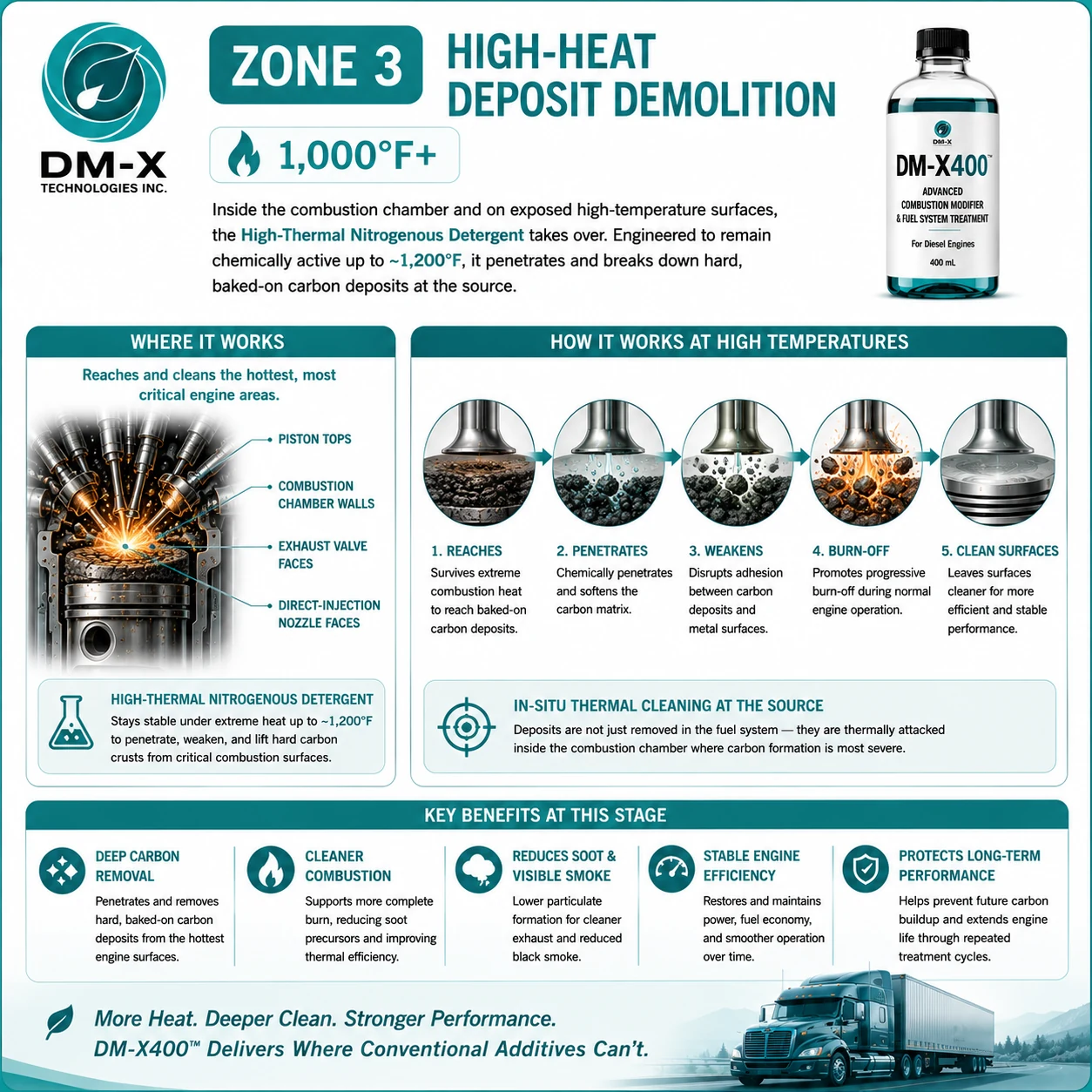
Engineered to remain chemically active in the combustion chamber and on exposed hot surfaces, where ordinary detergents can decompose too early to provide meaningful high-temperature cleaning.
Targets sticky lacquer, resinous films, and carbonaceous sludge around the intake tract, port adapters, fuel injectors, and near-combustion surfaces before these deposits harden further.
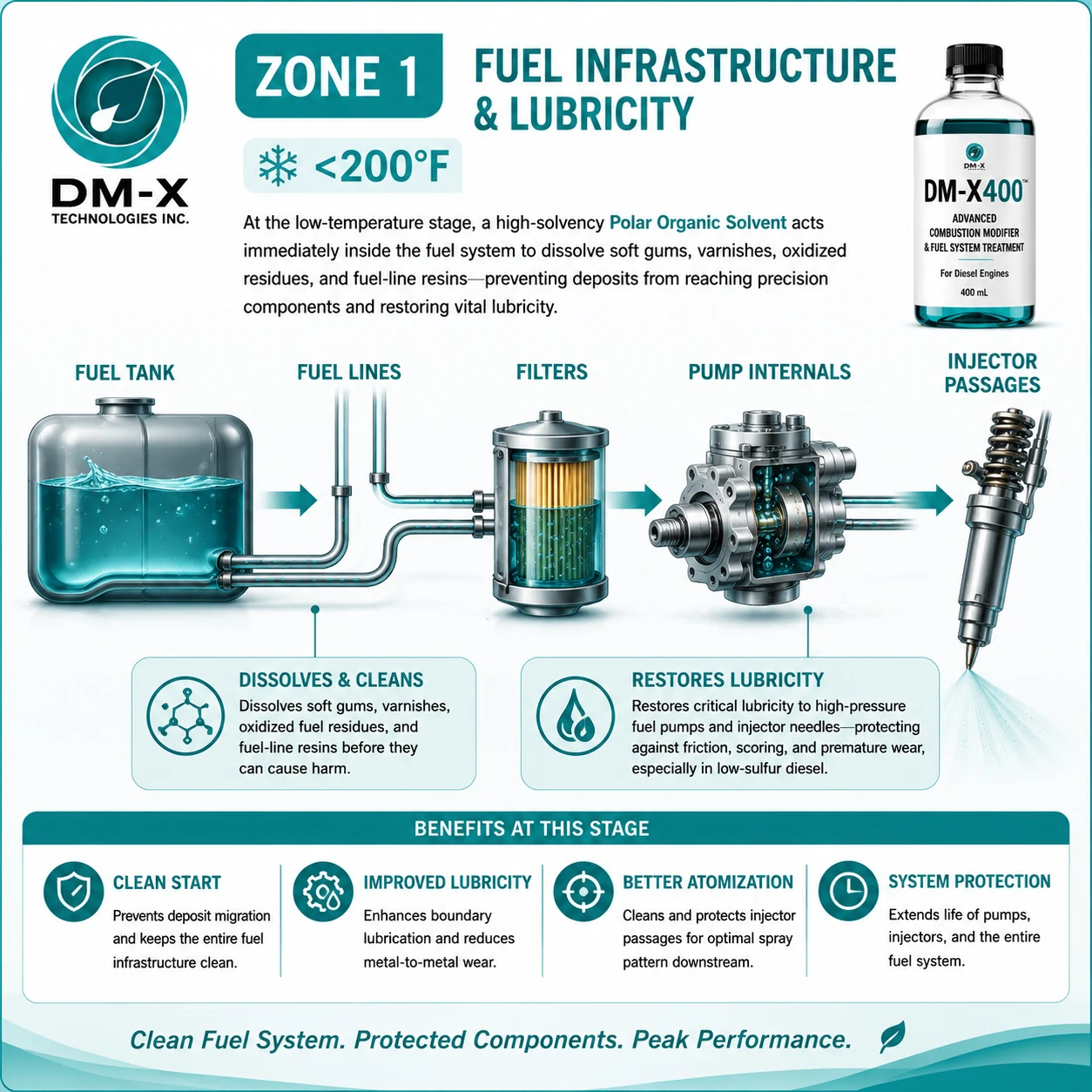
Begins working at low temperature in the tank, lines, filters, pump internals, and injector passages—dissolving soft gums, varnishes, oxidized fuel residue, and resins.
The proprietary matrix binds and carries the active chemistry, supports long-lasting protection, and functions as the formulation’s in-cylinder combustion-modification platform.
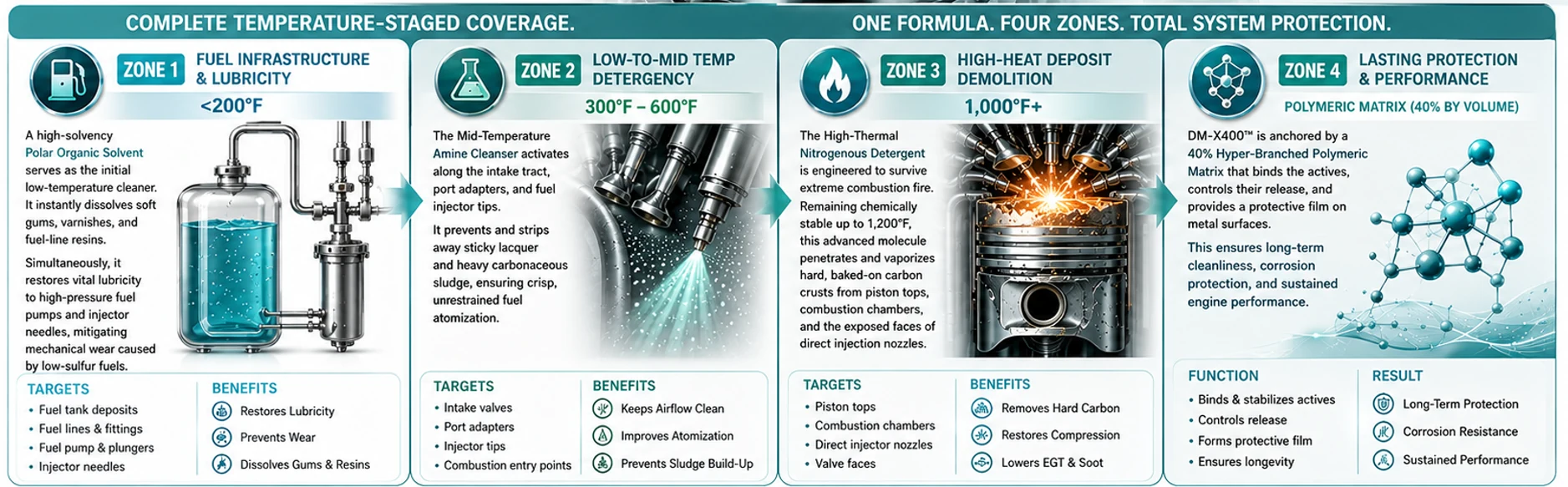
Fuel experiences radically different temperatures as it moves from storage to injection and combustion. DM-X400™ is structured so different parts of the formulation address different thermal environments.
Dissolves soft deposits and supports pumps and injector needles before the fuel reaches high-temperature components.
Removes sticky films and helps restore clean, unrestricted injector spray and airflow.
Targets hard, baked-on carbon on piston tops, chamber surfaces, valve faces, and nozzle faces.
The polymeric matrix carries the active system, supports corrosion resistance, and sustains treatment effects.
The treatment is intended to address contamination and performance losses progressively, rather than treating only one isolated component.
Soft residues, storage oxidation, water-associated sludge, and early contamination.
Gums and varnish that restrict flow or migrate toward precision hardware.
Cleaner upstream fuel helps reduce avoidable contaminant loading.
Lubricity support helps protect close-tolerance moving surfaces.
Deposit removal supports spray geometry, atomization, and cylinder balance.
High-heat chemistry and the polymeric matrix support cleaner conversion.
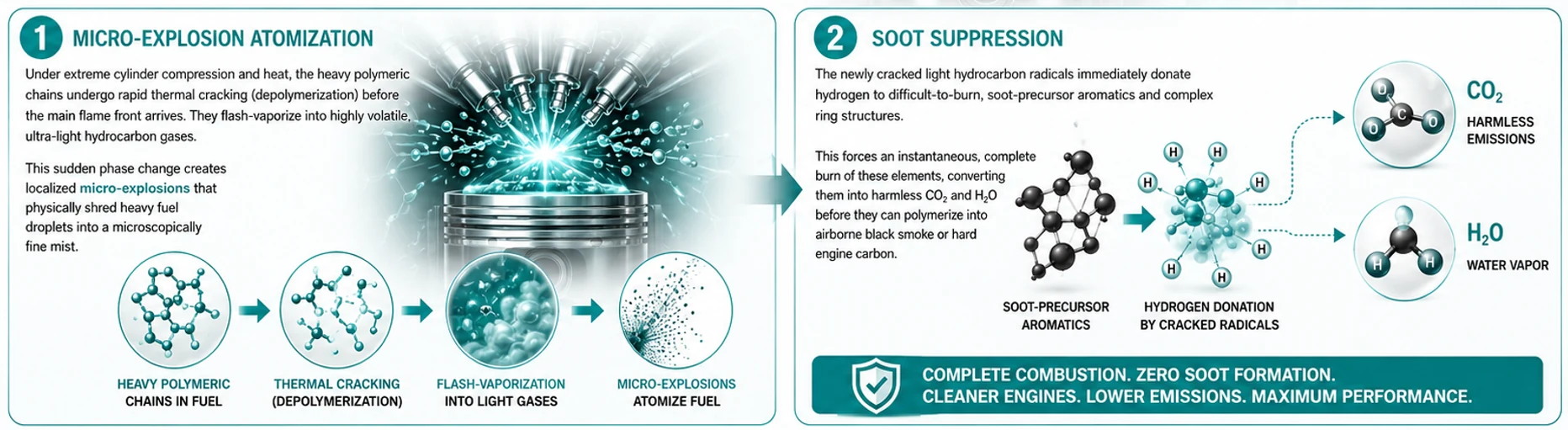
The product description attributes DM-X400™’s in-cylinder behavior to a two-step process involving rapid thermal cracking of the polymeric matrix and suppression of soot-forming pathways.
The proprietary 40% hyper-branched polymeric matrix is described as undergoing rapid thermal change under cylinder pressure and heat, immediately before and during the main combustion event.
Localized flash-vaporization helps fragment heavier fuel droplets into a finer mist, increasing the surface area available for oxygen contact and ignition.
Cracked light hydrocarbon radicals are described as supporting more complete conversion of difficult-to-burn aromatic structures before they agglomerate into soot.
The product proposition connects system cleanliness, injector precision, lubricity support, and combustion modification to practical fleet and engine outcomes.
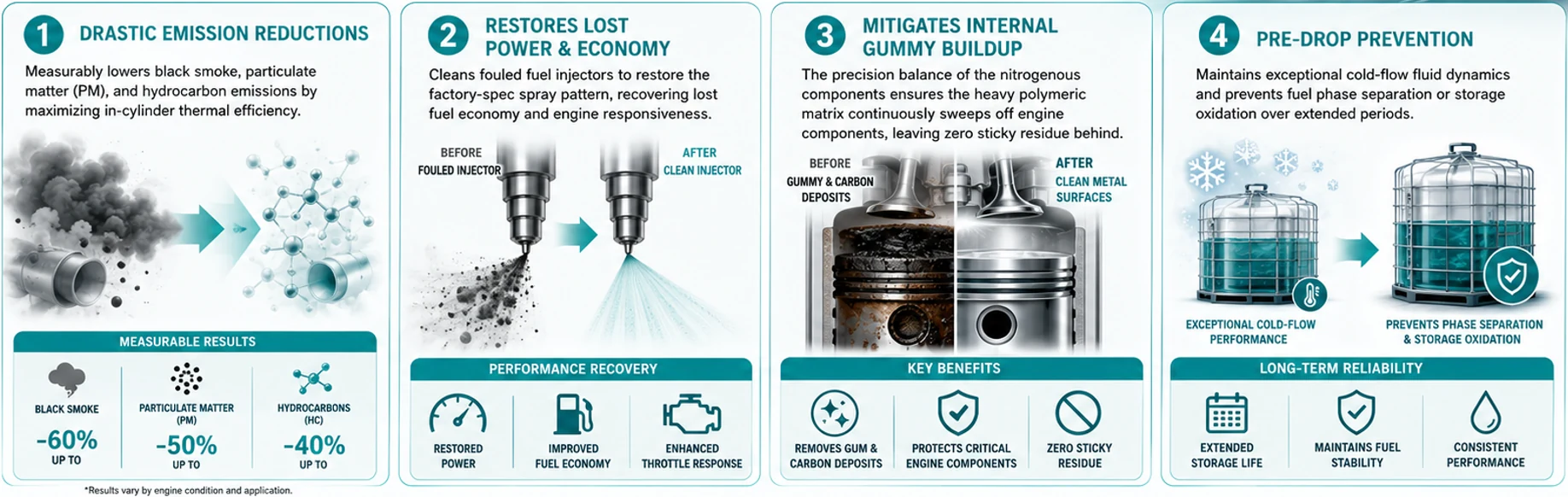
Cleaner injectors and more consistent combustion can help recover performance lost to deposits and poor spray quality.
Better atomization and lower combustion inefficiency can reduce the amount of fuel required for a comparable duty cycle.
Cleaner spray and more complete fuel conversion can reduce visible black smoke and soot-precursor formation.
Improved combustion quality and cleaner hardware can help reduce uneven firing, heat concentration, and contaminant-related stress.
Solvency, lubricity, and deposit control support the pumps, injectors, and passages that determine fuel-delivery precision.
The formulation is described as supporting cold-flow behavior and resisting phase separation or storage oxidation.
For a credible evaluation, compare like-for-like operation before and after treatment. The strongest evidence combines instrument readings with controlled fuel-use and maintenance data.
Use the same test equipment and test cycle before and after treatment, with the engine fully warmed.
Track fuel against distance, engine hours, payload, route, idle time, and ambient conditions—not a single fill-up.
Where diagnostic data is available, compare correction values, misfire behavior, idle stability, and response.
Inspect filters, fuel contamination, smoke behavior, operating temperature, and oil condition within the normal service program.
Different additive categories solve different problems. DM-X400™ is positioned as an integrated treatment that combines cleaning, lubricity, combustion modification, and storage support.
| Capability | Basic detergent treatment | Fuel stabilizer / lubricity additive | DM-X400™ integrated system |
|---|---|---|---|
| Tank and line residues | May provide limited solvency | Primarily preservation-focused | Polar solvent targets gums, varnishes, and oxidized residues |
| Injector-tip deposits | Primary area of focus | Usually secondary | Mid-temperature amine cleanser targets lacquer and sludge |
| High-heat carbon | Performance varies at extreme temperatures | Not the principal purpose | High-thermal detergent is designed for combustion-zone deposits |
| Fuel lubricity | May be limited | Often a core function | Solvent phase is described as restoring lubricity to precision hardware |
| Combustion modification | Generally no | Generally no | 40% polymeric matrix is described as supporting finer atomization and soot suppression |
| Storage / pre-drop support | Not always included | Common | Integrated with cleaning and combustion functions |
The strongest value case is usually found where high fuel use, long operating hours, soot loading, injector cleanliness, and equipment availability have direct economic consequences.
High-mileage engines, variable loads, idling, and sustained commercial duty.
Frequent stop-start operation, smoke sensitivity, and passenger-service uptime.
Dust, variable load, extended idle, and harsh operating environments.
Stored fuel, standby duty, load-step response, and reliability-critical operation.
Long run-times, fuel-quality variability, smoke control, and fuel-system protection.
Seasonal storage, heavy torque demand, and maintenance access constraints.
The product description identifies two operating strategies. Always reconcile these general instructions with the current bottle label, technical bulletin, fuel type, tank capacity, and fleet operating procedure.
For severe or legacy deposit buildup, the product description recommends adding one full bottle directly to the tank before refueling.
For ongoing fleet use, DM-X400™ may be applied at a highly diluted maintenance ratio intended to prevent deposit accumulation and preserve emissions performance.
The best fleet deployment combines correct dosing, controlled measurement, normal maintenance, and responsible interpretation of results.
No. It is presented as a multi-stage treatment combining low-temperature solvency, injector and intake detergency, high-heat carbon control, lubricity support, storage stability, and in-cylinder combustion modification.
Response depends on deposit severity, fuel volume, engine condition, load, and duty cycle. Injector cleanliness and smoke behavior may change during the treated fuel cycle, while hard carbon control may require repeated heat cycles and more than one treatment.
No. It may help address contamination-related performance losses, but damaged injectors, failed sensors, worn compression components, blocked filters, or defective emissions hardware require proper diagnosis and repair.
The product description supports a diluted preventative maintenance strategy. The exact continuous-use ratio must come from the current approved label or technical bulletin for the relevant fuel and application.
Cleaning a heavily deposited engine can alter soot and contaminant loading during the treatment cycle. Scheduling the treatment before normal oil service provides a practical point to renew the lubricant and inspect filters, while still following the engine’s approved maintenance schedule.
Use repeatable routes or load cycles, multiple baseline and treatment periods, calibrated instruments, and normalization for payload, idle time, ambient temperature, traffic, driver behavior, and fuel batch. Avoid relying on a single tank or subjective impressions alone.
A coordinated fuel treatment for operators who need cleaner combustion, restored response, protected fuel hardware, and a disciplined pathway to measurable fleet improvement.
