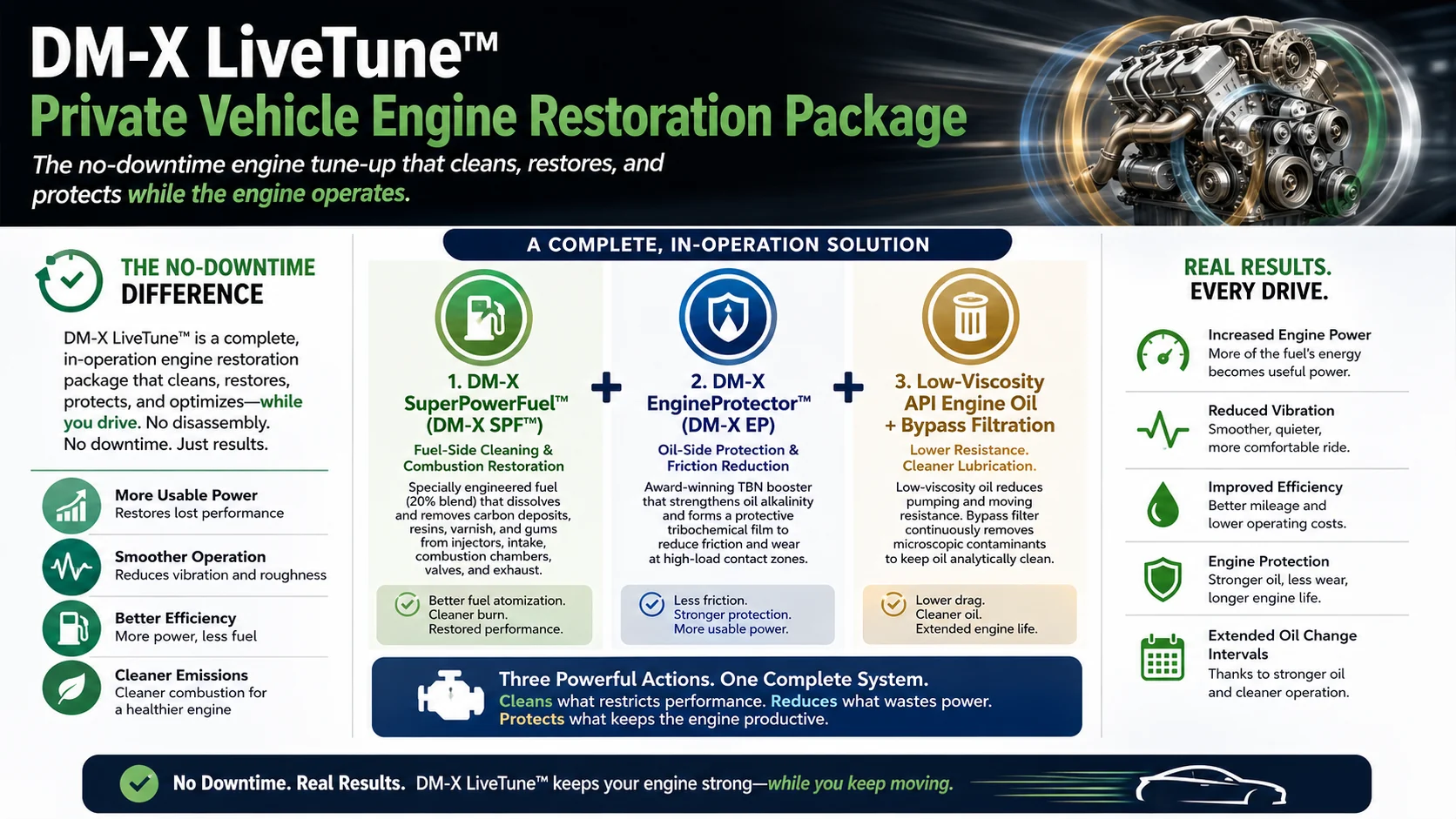
Clean the fuel side
Help remove deposits and residues that disturb fuel flow, injector spray quality, atomization, and combustion consistency.
DM-XLiveTune™ is a coordinated, no-downtime engine restoration package that addresses fuel delivery, combustion quality, friction control, lubricant flow, and microscopic contamination as one connected operating system.
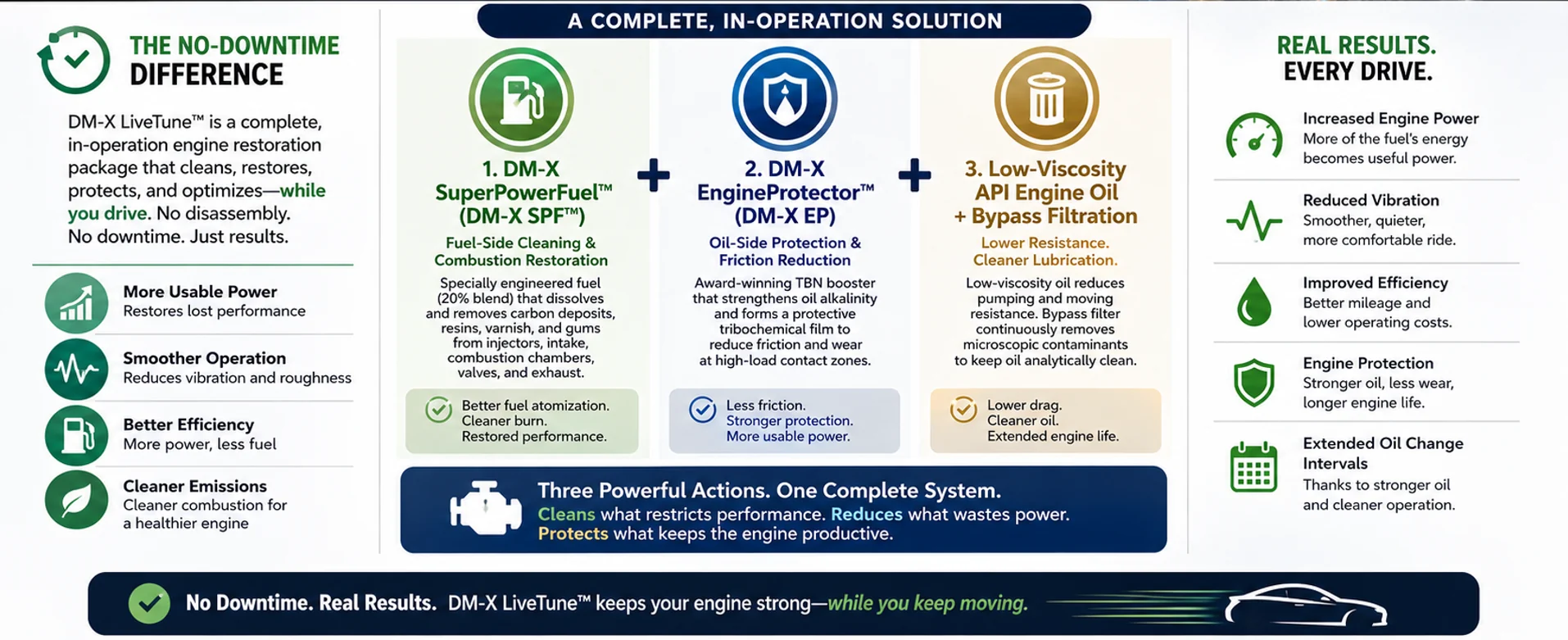
Instead of treating a dirty fuel system, high friction, degraded oil, and abrasive contamination as unrelated problems, DM-XLiveTune™ combines the relevant interventions into one coordinated service.
Help remove deposits and residues that disturb fuel flow, injector spray quality, atomization, and combustion consistency.
Strengthen the lubricant environment and reduce friction at high-load interfaces where heat, pressure, and wear stress are concentrated.
Use low-resistance API-rated oil and optional ultra-fine bypass filtration to improve flow while helping control microscopic abrasive particles.
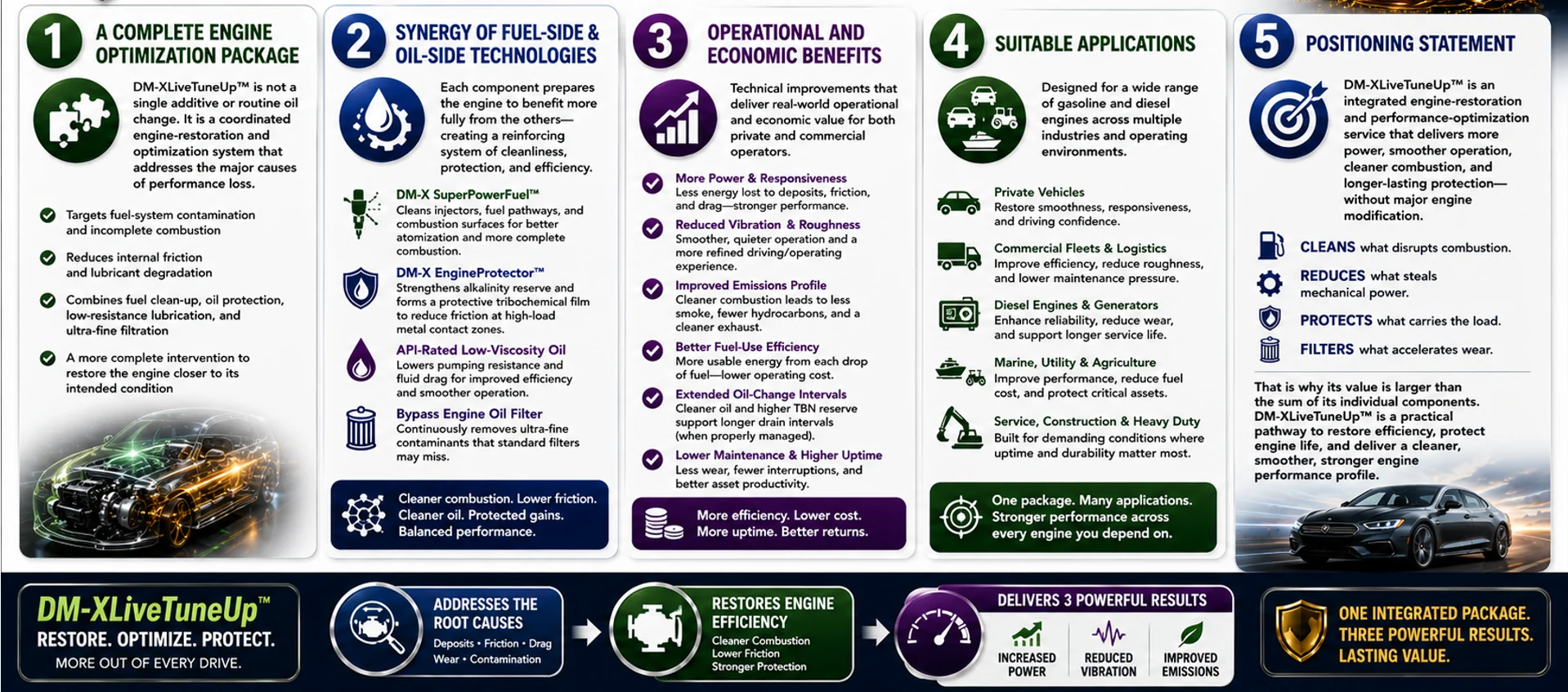
DM-XLiveTune™ is compelling because it is not dependent on a single mechanism. Each part of the package prepares the engine to benefit more fully from the others.
Deposits disturb combustion. Friction consumes mechanical energy. Dirty oil accelerates wear. Excessive lubricant resistance creates pumping losses. DM-XLiveTune™ is structured to reduce these losses together.
Cleaner burn: better fuel delivery and more consistent combustion.
Lower resistance: less energy consumed overcoming internal drag.
Stronger protection: a more resilient oil-side operating environment.
Cleaner circulation: fewer ultra-fine particles moving through the engine.
Can interfere with fuel flow, injector spray pattern, and the consistency of each combustion event.
Consumes part of the energy produced by combustion before that energy reaches the crankshaft.
Requires pumping energy and can reduce responsiveness, especially when oil flow is poorly matched to the application.
Particles smaller than the capture range of full-flow filtration can contribute to abrasive wear and oil degradation.
Every highlighted subject below is interactive. Select a button to understand what it does, why it matters, and what a vehicle owner may reasonably notice.
A specially engineered gasoline or diesel fuel blended at approximately 20% DM-X SPF with 80% of the vehicle’s existing fuel. It is designed to help dissolve and disperse deposits in fuel pathways, injectors, intake and combustion areas, valves, piston crowns, and exhaust pathways while the engine continues to operate.
An extreme-pressure engine-oil TBN booster formulated to strengthen alkalinity reserve, help the oil resist acid build-up and oxidation stress, and support a protective tribochemical film at high-load metal-contact zones.
0W-20 for suitable gasoline engines and 5W-30 for suitable diesel engines are used to lower pumping losses, improve oil circulation, and allow more combustion energy to become useful crankshaft output rather than lubricant resistance.
An optional but highly recommended secondary loop that diverts a small portion of the oil stream through dense filter media, capturing microscopic contaminants that standard full-flow filtration may miss without restricting the engine’s primary lubrication flow.
The service logic is practical: establish the vehicle’s baseline, apply the coordinated package, allow normal operation to carry out the restoration process, and verify the results.
Review engine condition, oil specification, visible smoke, vibration, fuel use, and any known mechanical faults before treatment.
Select the appropriate DM-X SPF blend, DM-X EngineProtector™, API-rated oil grade, and optional bypass filtration arrangement.
The fuel-side and oil-side components work progressively during ordinary engine operation rather than requiring major disassembly.
Compare power response, vibration, exhaust condition, fuel consumption, and oil condition against the documented baseline.
The low-viscosity oil, DM-X EngineProtector™, and bypass filter form a three-part oil-side strategy: improve flow, reinforce protection, and preserve cleanliness.
Low-viscosity oil reduces hydrodynamic drag and pumping resistance. DM-X EngineProtector™ reinforces the oil-side protection environment. Bypass filtration helps remove ultra-fine contaminants that can accelerate abrasion and additive depletion.
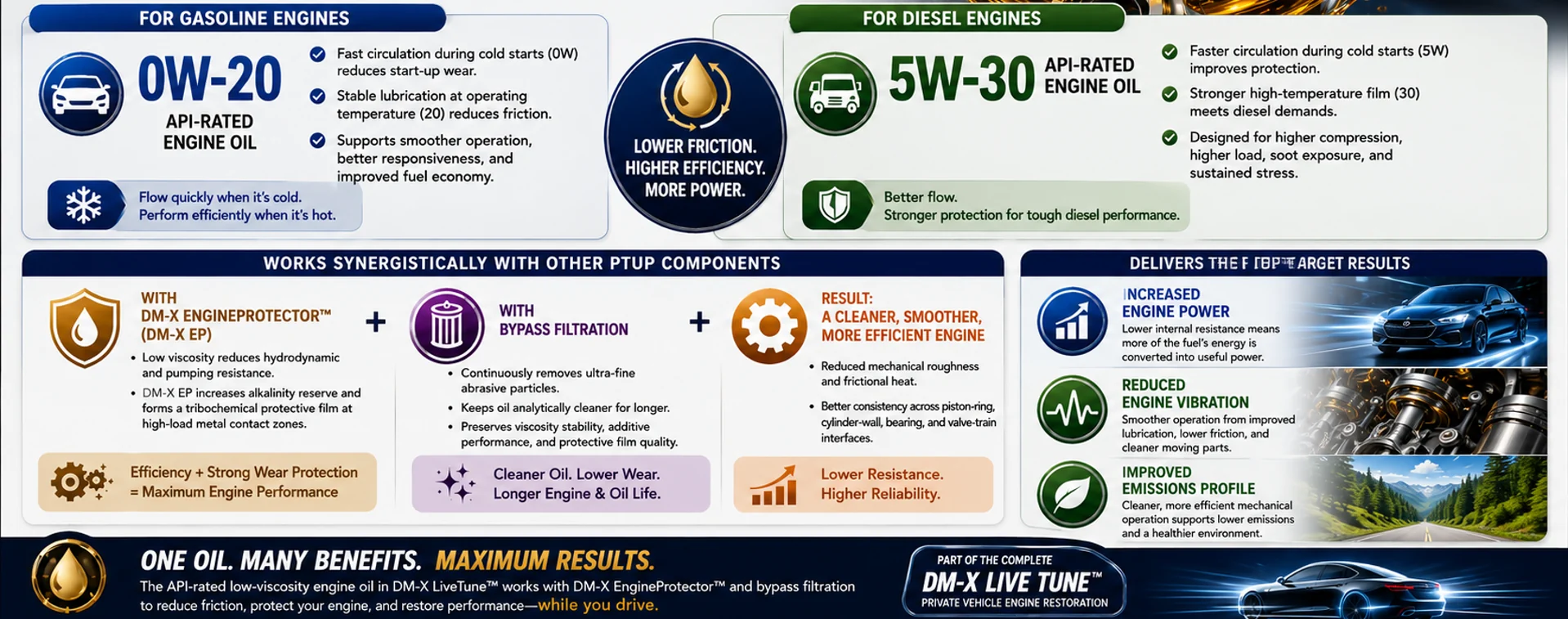
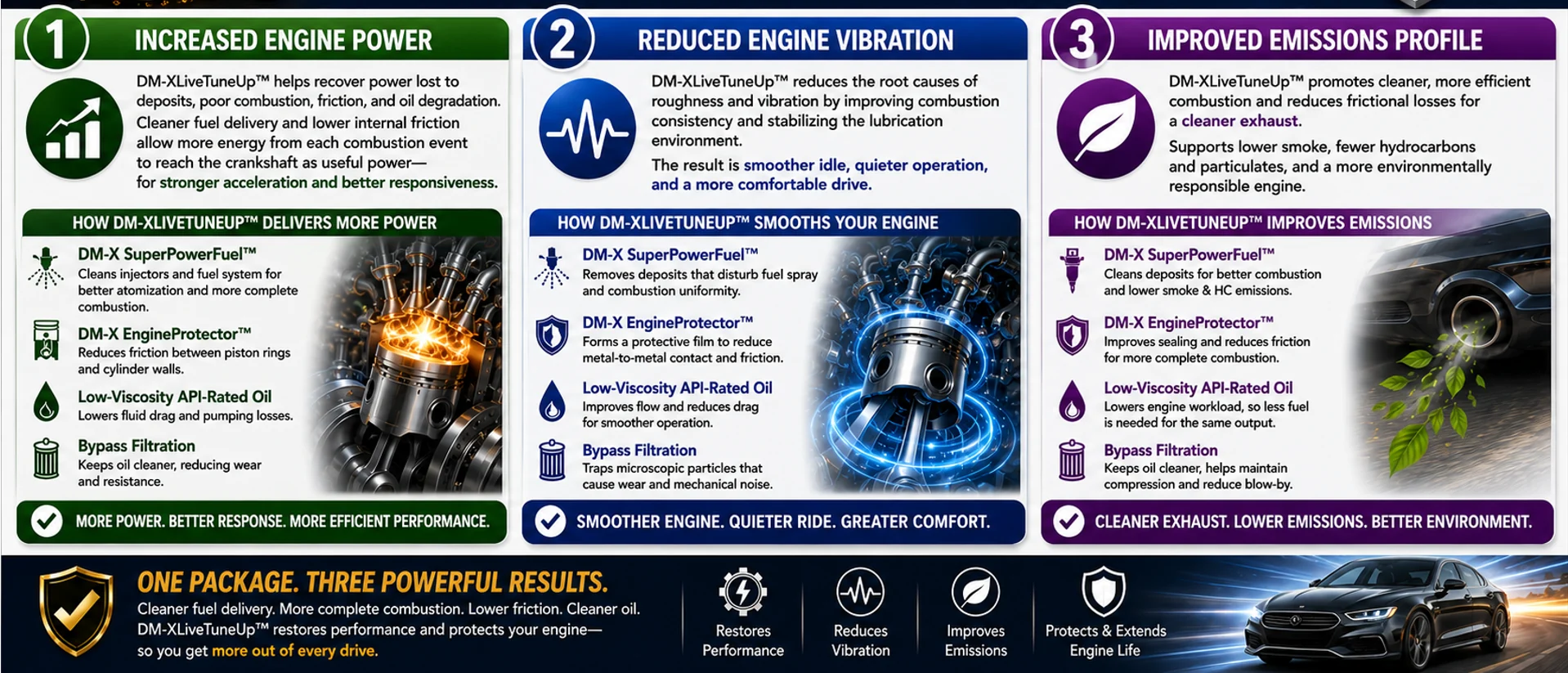
Power, vibration, and exhaust quality are connected. Cleaner combustion releases energy more consistently; lower friction wastes less of it; cleaner lubrication helps preserve the improvement.
Helps recover useful output lost to dirty fuel delivery, incomplete combustion, internal friction, lubricant drag, and oil contamination.
Helps address uneven firing, rough combustion, harsh metal contact, dirty oil, and inconsistent cylinder-to-cylinder operation.
Supports more complete combustion, lower frictional demand, reduced visible smoke, and a cleaner exhaust signature in deposit-affected engines.
A compelling product proposition becomes stronger when it includes a clear before-and-after protocol. The vehicle’s condition should be documented rather than inferred from subjective impressions alone.
Engine condition and use profile differ from vehicle to vehicle. A disciplined baseline and follow-up check turns the service into an evidence-led restoration program.
Record idle and operating vibration before treatment, then compare under the same conditions after the restoration cycle.
Use appropriate opacity, smoke, hydrocarbon, carbon-monoxide, or other available emissions measurements for the engine type.
Compare fuel consumption over representative routes, loads, and driving conditions rather than relying on a single short trip.
Use oil analysis where extended service intervals or lubricant-condition claims are being considered.
The comparison is conceptual: it shows which engine loss mechanisms each approach is designed to address, not a guarantee that every engine will respond identically.
| Service approach | Fuel-side deposits | Oil-side friction | Lubricant flow | Ultra-fine contaminants | Integrated restoration |
|---|---|---|---|---|---|
| Routine oil change | Not normally addressed | Depends on oil selected | Yes | Limited to standard filtration | Partial |
| Fuel cleaner alone | Primary focus | Not directly addressed | Not addressed | Not addressed | Partial |
| Oil additive alone | Not directly addressed | Primary focus | Depends on formulation | Not addressed | Partial |
| DM-XLiveTune™ | DM-X SuperPowerFuel™ | DM-X EngineProtector™ | Application-specific API-rated oil | Optional bypass filtration | Coordinated system |
The product described here is the private-vehicle package. The same restoration architecture can be adapted to other engine-driven assets where uptime, fuel use, oil condition, and durability affect operating economics.
Restore responsiveness, smoothness, confidence, and day-to-day operating efficiency.
Support repeatable service protocols, reduced roughness, and condition-based operating-cost control.
Apply the same fuel-side and oil-side logic where long operating hours magnify modest efficiency gains.
Support cleaner lubrication and uptime for equipment where reliability is direct economic value.
These answers clarify the intended positioning of the package and reinforce the importance of engine condition, correct oil selection, and measured validation.
No. It is positioned as a coordinated service package. The fuel-side treatment, DM-X EngineProtector™, application-specific oil, and optional bypass filter each address a different source of lost efficiency and are intended to reinforce one another.
It means the restoration chemistry and lubrication strategy are designed to work while the engine operates, without major engine disassembly. Normal service preparation, oil changes, inspection, and any bypass-filter installation still require appropriate workshop time.
No. The oil must meet the engine manufacturer’s viscosity and performance requirements. The package should be configured for the specific engine, ambient conditions, duty cycle, and service history.
No fixed extension should be assumed. Longer service intervals should be supported by oil condition, operating history, manufacturer requirements, and preferably used-oil analysis.
Useful checkpoints include engine response, vibration, visible smoke or measured emissions, fuel-use trend, oil cleanliness, and any relevant diagnostic information. Mechanical faults should be repaired rather than attributed to deposits or lubricant condition.
DM-XLiveTune™ is an integrated engine-restoration and performance-optimization service for operators who want more usable power, smoother operation, cleaner combustion, and longer-lasting lubrication protection without major engine modification.
Return to the overview